
HWT supplied a containerised water treatment plant for the Massawa mining operation in Senegal, designed to produce 50 m³/day of potable water for the mine campsite.
The treatment system is housed within two modified 6 m shipping containers and incorporates pH correction, flocculation, sedimentation, AFM filtration, activated carbon filtration and final disinfection.
The complete plant is fully automated, allowing reliable potable-water production with minimal operator intervention. Treated water is produced to comply with the requirements of SANS 241 for drinking water before being transferred to the site’s clean-water storage reservoir.
Containerised Water Treatment Plant Massawa
Raw water is supplied from a storage tank provided by others and is abstracted into the HWT treatment system.
Because raw-water quality determines the treatment processes required, several treatment stages are incorporated before the water is considered suitable for potable use.
The plant has been designed as an integrated treatment system, with the principal mechanical, electrical, filtration and control equipment housed within two shipping containers.
This provides a compact installation that is particularly suitable for remote mining and camp applications.
pH Adjustment
The first chemical treatment stage incorporates pH adjustment.
Correct pH is important for the subsequent treatment processes and allows the downstream flocculation stage to operate under suitable chemical conditions.
Chemical dosing is therefore incorporated into the automated treatment process so that the required water chemistry can be maintained.
Flocculation and Sedimentation
Following pH adjustment, the water undergoes flocculation and sedimentation.
During flocculation, fine suspended and colloidal material is encouraged to combine into larger particles or flocs. These particles can then be separated from the water during the sedimentation stage.
This substantially reduces the suspended-solids loading presented to the downstream filtration equipment.
AFM Filtration
After clarification, the water is passed through Activated Filter Media (AFM) filters.
AFM filtration provides a polishing stage for the removal of residual suspended material and turbidity remaining after sedimentation.
By reducing turbidity at this stage, the downstream treatment processes are provided with consistently clarified water.
Granular Activated Carbon Filtration
The next treatment stage incorporates granular activated carbon (GAC).
Activated carbon is used to improve the aesthetic quality of the treated water by removing residual colour and odour.
GAC also provides adsorption of certain dissolved organic compounds that may be present in the incoming water.
Final Water Polishing
Following the principal media-filtration stages, a bag filter is provided for final treated-water polishing.
This acts as an additional physical barrier and removes residual particulate material before the water reaches the final disinfection stages.
Dual Water Disinfection
Potable water disinfection is provided using both liquid chlorine and ultraviolet (UV) treatment.
UV provides an effective physical disinfection barrier, while chlorine provides chemical disinfection and allows a disinfectant residual to be maintained within the treated-water system.
The combination provides two complementary disinfection processes before the water is transferred to storage.
SANS 241 Drinking-Water Quality
The Massawa water treatment plant has been designed to produce potable water compliant with SANS 241, the South African drinking-water quality standard specified for the project.
Following treatment and disinfection, the potable water is discharged to a clean-water storage reservoir supplied by others.
As with any potable-water installation, final compliance should be confirmed through appropriate sampling and laboratory analysis of the treated water.
Automated Operation and Monitoring
The complete treatment process is controlled through an interactive control panel.
Instrumentation includes flow and electrical power measurement, allowing important operating parameters to be monitored as part of the automated system.
High-duty PVC pipework is used throughout the treatment plant to provide a robust and corrosion-resistant process piping system.
Because the system is fully automated, routine operator involvement can be kept to a minimum while the principal treatment processes remain controlled.
Containerised Water Treatment for Remote Mines
Remote mining operations frequently require reliable potable-water production in areas where conventional municipal water infrastructure is unavailable.
Containerisation provides a practical solution.
Much of the process equipment can be installed, piped, wired and tested before shipment. Consequently, the amount of assembly required at the final site can be reduced.
For the Massawa installation, two modified 6 m shipping containers accommodate a complete multi-stage potable-water treatment process capable of producing 50 m³/day.
The combination of clarification, AFM filtration, activated carbon, final polishing and dual disinfection provides a robust treatment train for the production of high-quality potable water at a remote mining campsite.
HWT Potable Water Treatment Plants
HWT designs and supplies potable water treatment plants for mines, construction camps, residential developments, farms, lodges and other off-grid applications.
Treatment systems are developed according to the available raw-water quality, required production capacity and final treated-water specification.
Plants can be supplied as containerised or skid-mounted systems, allowing much of the equipment to be assembled and tested before delivery to site.
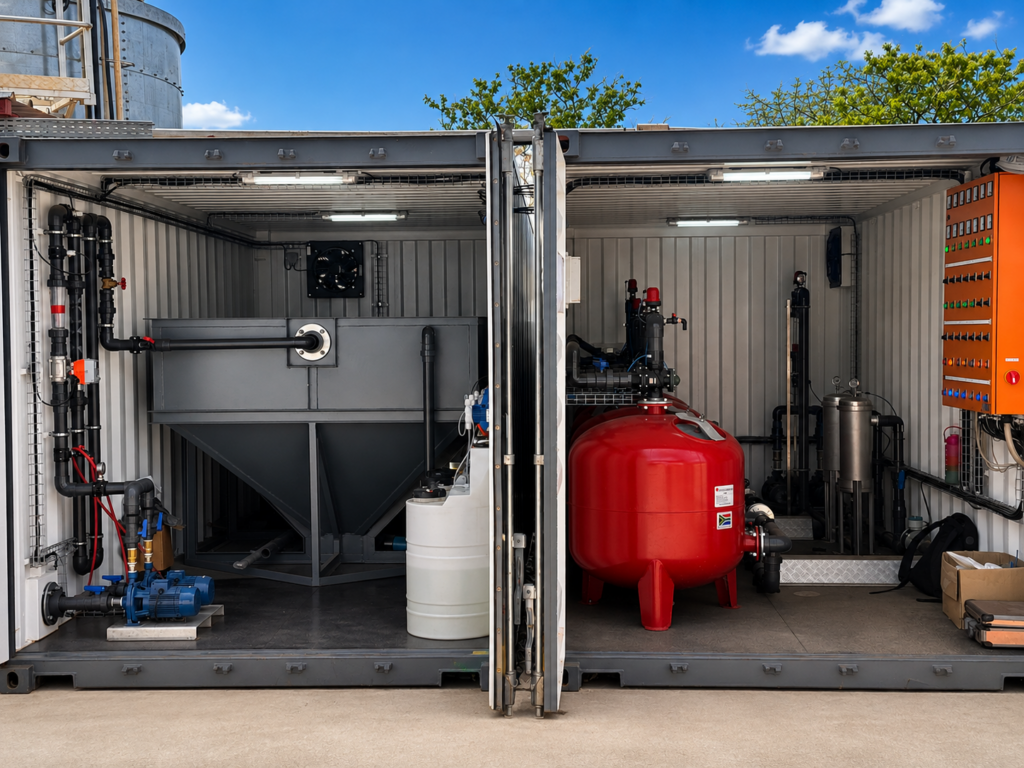
Clarifier, filtration and control room

4 x CONN40 AFM filters


