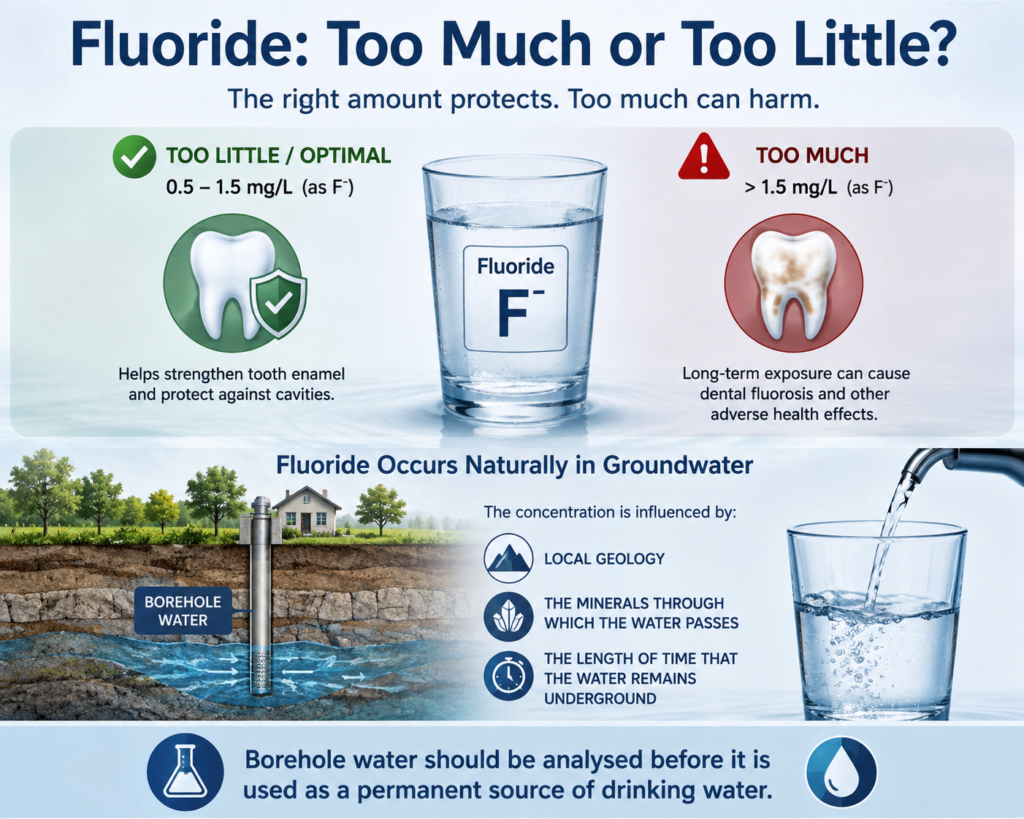
Fluoride in drinking water is an interesting water-quality parameter because both the concentration and the overall exposure need to be considered. At appropriate levels, fluoride has long been associated with protection against dental cavities. However, excessive fluoride exposure can result in adverse effects, particularly when elevated concentrations are consumed over long periods.
Fluoride occurs naturally in groundwater and is therefore frequently encountered in borehole water. The concentration is influenced by local geology, the minerals through which the groundwater passes and the length of time that the water remains underground.
Consequently, borehole water should be analysed before it is used as a permanent source of drinking water.
How Much Fluoride Is Too Much?
The World Health Organization (WHO) guideline value for fluoride in drinking water is 1.5 mg/L.
Above this concentration, the likelihood of dental fluorosis increases as exposure increases. At considerably higher concentrations and with prolonged exposure, more serious effects can occur.
However, fluoride exposure does not come exclusively from drinking water. Food, beverages, toothpaste and other sources may also contribute. Therefore, local conditions and total fluoride exposure should be considered when drinking-water quality is assessed.
Fluoride in Drinking Water – Can There Be Too Little?
Interestingly, fluoride differs from many other drinking-water constituents because a very low concentration is not necessarily considered beneficial from a dental-health perspective.
At suitable concentrations, fluoride can contribute to the prevention of dental cavities. This is why fluoride has historically been deliberately added to drinking water in some countries.
Nevertheless, the objective of a water treatment plant should not simply be to achieve the lowest possible fluoride concentration. Instead, the water should be treated to achieve a safe and appropriate drinking-water quality.
Removing Fluoride from Borehole Water
Where excessive fluoride is detected, several treatment technologies can be considered.
Reverse osmosis (RO) is commonly used where fluoride occurs together with elevated dissolved salts or other undesirable minerals. During reverse osmosis, water is passed through a semi-permeable membrane and a substantial proportion of the dissolved contaminants, including fluoride, is rejected.
Alternatively, activated alumina can be used specifically for fluoride removal. Other specialised adsorption media may also be considered depending on the raw-water chemistry and required treated-water quality.
The appropriate process should therefore be selected only after a representative laboratory analysis has been reviewed.
Borehole Water Should Be Tested
Fluoride cannot normally be identified by the appearance, taste or smell of the water. A borehole may produce beautifully clear water while still containing an undesirable fluoride concentration.
For this reason, laboratory analysis should be undertaken before borehole water is approved for drinking purposes.
At HWT, raw-water analyses are reviewed and appropriate treatment processes are selected according to the contaminants present and the intended use of the treated water.
Ultimately, good water treatment is not simply about removing everything from the water. The objective is to produce water with the right chemistry for its intended purpose.