
A Limestone Pebble Contact Tank is a simple and effective process used for the correction of low pH water and the improvement of alkalinity. In many groundwater, rainwater, and surface water treatment applications, water is produced with insufficient alkalinity and can therefore become corrosive to pipes, pumps, valves, and storage tanks. Consequently, a limestone contact system is often installed to provide natural pH correction and water stabilisation.
Limestone Pebble Contact Tank Configurations
Two common configurations are generally used for limestone contact systems. Although the same treatment principle is applied, different hydraulic arrangements can be selected to suit the application.
As water comes into contact with limestone pebbles, calcium carbonate is dissolved gradually. As a result, alkalinity is increased and the pH is raised. Furthermore, aggressive water conditions are reduced, and corrosion risks can be minimised without the need for extensive chemical dosing systems.
Upflow Limestone Pebble Contact Tank
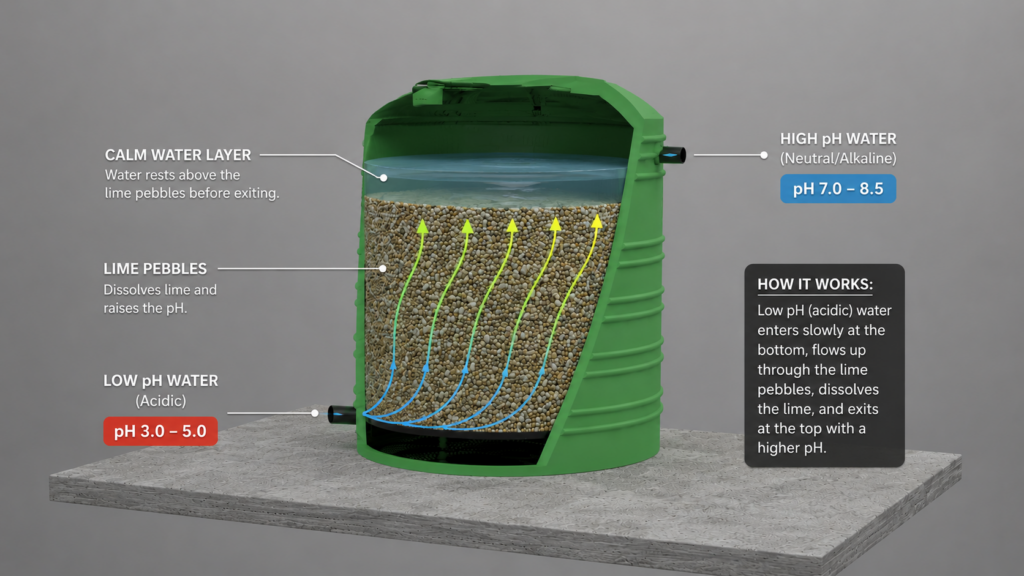
In the upflow configuration, low pH water is introduced at the base of the vessel. The water is then distributed evenly beneath a bed of limestone pebbles. As the water rises through the media, close contact is achieved between the water and the limestone.
Subsequently, calcium carbonate is dissolved into the water, and alkalinity is increased. Finally, stabilised water is collected from the top of the vessel and conveyed to storage or further treatment processes.
The upflow design is often preferred because media utilisation is maximised and short-circuiting is minimised. Additionally, good contact times can be achieved with relatively compact tank dimensions.
Spray-From-Above Limestone Contact Tank
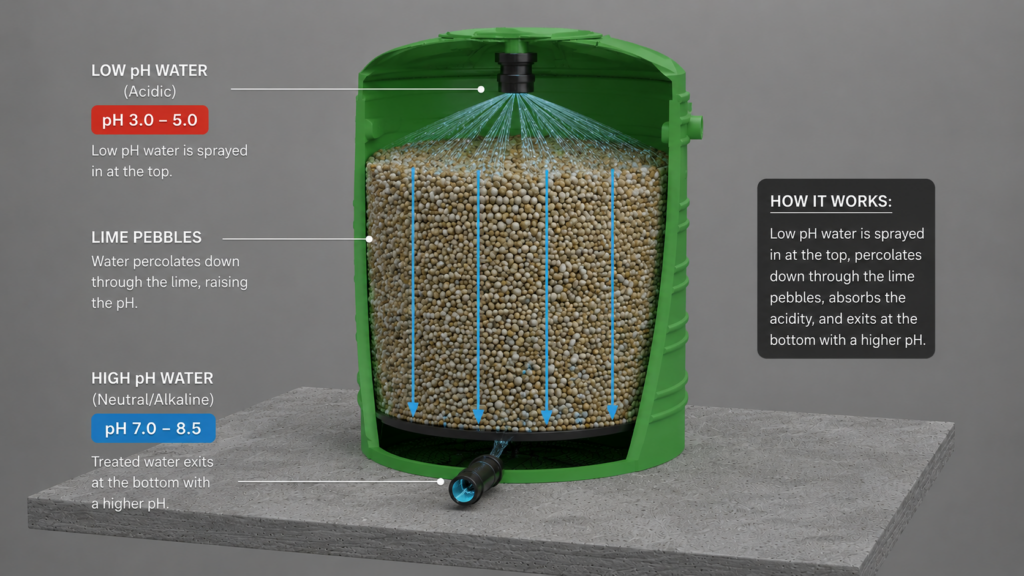
Alternatively, water may be sprayed onto the top of a limestone pebble bed. In this arrangement, low pH water is distributed through spray nozzles or a perforated distribution manifold positioned above the media.
Thereafter, the water percolates downward through the limestone bed under gravity. During this process, calcium carbonate is dissolved and alkalinity is imparted to the water. Eventually, stabilised water is collected at the base of the tank.
This configuration is frequently selected where simple gravity operation is desired. Moreover, visual inspection of the distribution system can be performed easily, and maintenance access is generally improved.
Applications and Benefits
Limestone contact tanks are widely used for borehole water treatment, rainwater treatment, potable water production, reverse osmosis permeate stabilisation, and industrial water conditioning. In addition, they can be incorporated into containerised and skid-mounted treatment plants.
Because naturally occurring limestone is utilised, operating costs are generally reduced. Furthermore, chemical handling requirements are minimised, and a stable water quality can be achieved. As a result, limestone pebble contact tanks continue to be regarded as a reliable and economical solution for long-term pH correction and alkalinity enhancement.
Need a Custom Treatment Solution?
Partner with HWT to design a treatment system tailored to your operational requirements.
Get in touch with our engineering team todayResearch into limestone pebble contact tanks for water stabilisation was supported by the South African Water Research Commission (WRC). Studies were undertaken to evaluate the effectiveness of limestone media in increasing alkalinity, raising pH, and reducing the corrosive nature of low-mineral waters. As a result, valuable design and operational guidance was developed for the implementation of limestone contact systems in South African water treatment applications.