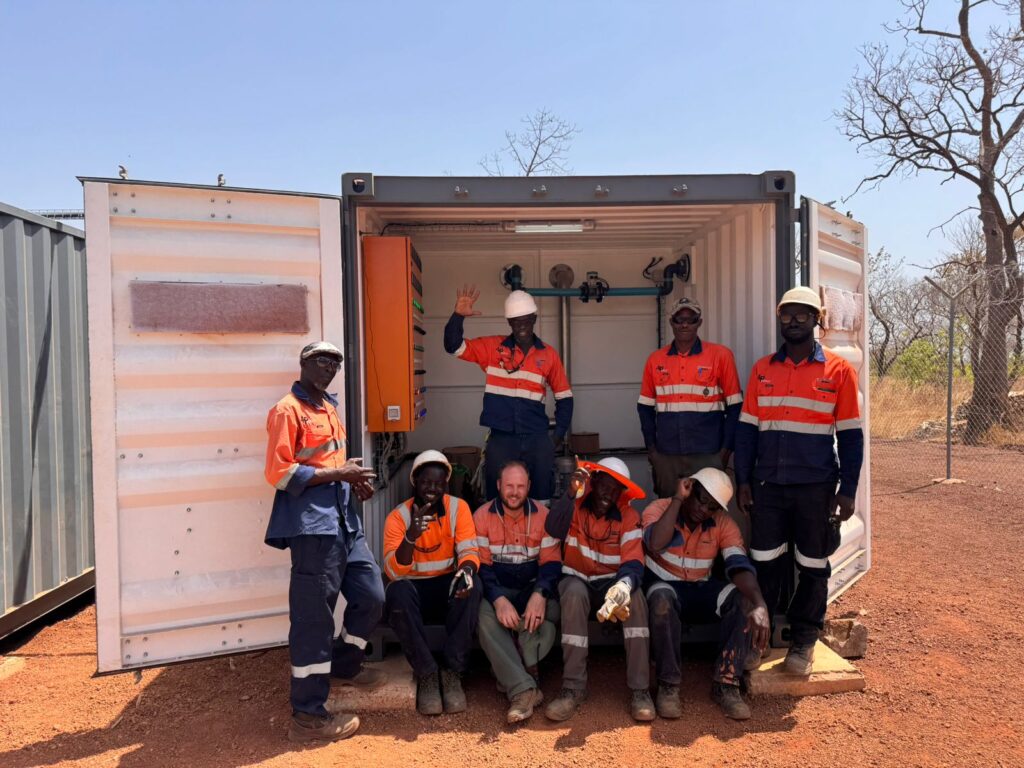
HWT supplied and installed a sewage treatment plant at Massawa Camp in Senegal, designed to treat 40 m³/day of domestic sewage from approximately 350 people.
The treatment plant was developed as an upgrade to the existing wastewater infrastructure at the camp. Existing tanks were incorporated into the new treatment process for flow balancing and solids separation, while the principal biological treatment processes were installed within four interconnected modified 6 m shipping containers.

The result is a compact, modular and fully automated sewage treatment system designed for reliable operation in a remote mining environment with minimal operator intervention.
Sewage Treatment Plant Massawa Senegal
The treatment philosophy was developed to make effective use of the infrastructure already available at the site.
Incoming domestic sewage is directed to the existing sewage treatment works. Rather than abandoning the existing tanks, they have been incorporated into the upgraded treatment process and are used for hydraulic balancing and separation of solids before wastewater is transferred to the biological treatment stage.
This approach allowed useful existing infrastructure to be retained while a substantially upgraded biological treatment process was provided.
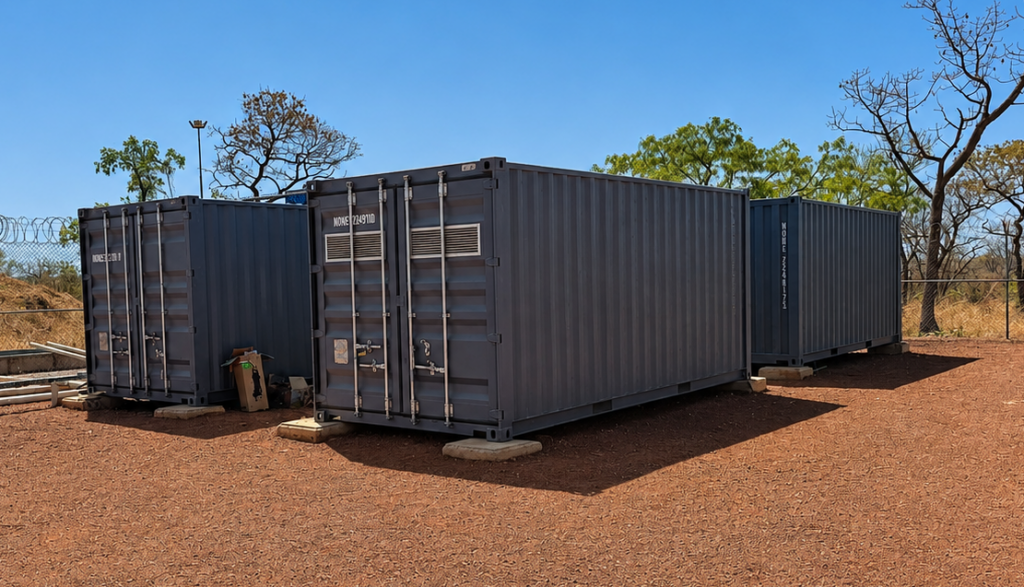
Containerised Biological Treatment
The principal biological treatment processes are housed within four interlinked modified 6 m shipping containers.
Containerised construction is particularly well suited to remote mining operations. Much of the mechanical, electrical and process equipment can be installed and tested before shipment, thereby reducing the amount of construction and assembly required at site.
The interconnected containers provide the process volumes required for biological treatment while creating a compact and robust treatment system.
Within the biological process, organic pollutants contained in the domestic sewage are removed through microbial activity. Treatment is also provided for dissolved nitrogen compounds, allowing a high-quality treated effluent to be produced.
Beneficial Reuse of Treated Sewage
An important feature of the Massawa Camp installation is that the treated wastewater can be regarded as a water resource rather than simply a waste stream.
Following treatment, the water can be reused for several non-potable applications around the mining operation, including:
- Irrigation
- Toilet flushing
- Dust suppression
- Fire-control water
Where reuse is not required, provision can also be made for the safe discharge of treated effluent to the environment, subject to applicable local environmental requirements.
For remote mining operations, this approach can be particularly valuable. Water that would otherwise be discharged can be recovered and used to reduce demand on other water resources.
Treated Water Quality
The treatment plant was designed to produce treated effluent compliant with the South African Department of Water and Sanitation (DWS) General Limit specified for the project.
The DWS General Limit defines acceptable concentrations for a range of physical, chemical and microbiological parameters associated with wastewater discharge.
Fully Automated Operation
The Massawa sewage treatment plant has been designed as a fully automated system requiring minimal operator intervention.
Process equipment, instrumentation and controls are integrated so that the principal treatment functions can be managed automatically.
This is particularly advantageous at mining camps and remote installations, where wastewater treatment needs to remain reliable without requiring continuous attendance by a dedicated process operator.
Factory Testing Before Shipment
An important part of the project delivery philosophy is the completion of as much assembly and testing as practical before the equipment is transported to site.
Factory testing allows mechanical equipment, electrical systems, instrumentation and control functions to be inspected and tested under controlled conditions.
Consequently, potential problems can be identified before shipment, while installation and commissioning activities at the remote site can be simplified.
Modular Sewage Treatment for Mining Camps
Mining camps present particular wastewater-treatment challenges. They are frequently located far from municipal infrastructure, while reliable sewage treatment is nevertheless required every day.
The Massawa Camp plant demonstrates how existing infrastructure and modular containerised treatment technology can be combined to provide an effective solution.
With a design capacity of 40 m³/day, the system provides sewage treatment for approximately 350 people, while treated-water reuse allows the resulting effluent to contribute to irrigation, toilet flushing, dust suppression and fire-control requirements.
The use of four interconnected shipping containers also provides a modular treatment arrangement that can be manufactured largely off site and transported to the point of use.
HWT Sewage Treatment Plants for Mining Operations
HWT designs and supplies containerised and modular sewage treatment plants for mines, construction camps, residential developments and other off-grid applications.
Each system is designed according to the incoming wastewater characteristics, population served, hydraulic loading, required treated-water quality and intended reuse or discharge application.
For remote installations such as Massawa Camp, the objective is straightforward: reliable sewage treatment, efficient water reuse and minimal operator intervention.